
Arrest Records in St. Louis City
The St. Louis Metropolitan Police Department is the primary City arresting agency, but Missouri State Highway Patrol officers, federal agencies, transit or campus police, and other special police can also make arrests within their authority. The creating agency holds the incident and arrest report. When a person enters local custody, the St. Louis City Division of Corrections creates a separate booking record at the City Justice Center. The elected Sheriff mainly handles court security, process, prisoner transport, and court-related custody actions. It is not the general custodian for SLMPD reports or CJC booking files.
An arrest history is a chain of events, not one document. The agency report states the alleged facts and authority for the arrest. Corrections records intake, custody, holds, bond, and release. MSHP may receive a fingerprint-based arrest cycle. The Circuit Attorney decides whether to file state charges, and the 22nd Judicial Circuit opens a case only after filing. Each custodian answers a different question.
Four St. Louis City Arrest Custodians
Following one St. Louis City arrest often requires four stops. SLMPD or another arresting body holds the narrative report. City Corrections holds the booking and custody record. The Circuit Clerk holds filed charges and the court outcome. MSHP CJIS holds the statewide event-based criminal-history record when reporting rules apply. A gap in one channel does not cancel a record in another.
| Custodian | Record | Best access channel |
|---|---|---|
| SLMPD or creating agency | Incident and arrest report | City GOVQA or the agency’s own records process |
| City Division of Corrections | Booking, custody, bond, and release | City inmate locator, CJC phone, or GOVQA |
| 22nd Judicial Circuit | Filed charges, docket, judgment, sentence | Case.net and the Circuit Clerk |
| MSHP CJIS | Open statewide criminal-history events | MACHS name or fingerprint channel |
The route also changes after transfer. City pretrial custody belongs in the City locator. A person sent to state prison, probation, parole, or conditional release belongs in the Missouri DOC Offender Search. Federal detention and charges use federal agency and court systems.
St. Louis City Arrest Lookups
Start with the channel closest to the event. A very recent booking may still be processing, while a released person may no longer appear in a current-custody search. Use a full legal name and, when available, the CJC master number, police report number, court case number, event date, and location. Those identifiers help separate people with similar names and let staff locate older material.
- Search the official St. Louis City inmate locator for current custody. If the booking is new or the result is unclear, call CJC at 314-621-5848.
- Search Case.net under “City of St. Louis – 22nd Judicial Circuit” to see whether prosecutors filed a state or municipal case.
- Request the arrest or incident report from SLMPD through City GOVQA, giving the event date, place, and report number when known.
- Use MACHS for open Missouri criminal-history information. Use the fingerprint channel for identity-confirmed review of one’s own state record.
- For released-person booking history, a letter of incarceration, or records not online, contact Corrections by phone or submit a precise GOVQA request.
- For state prison or supervision after the City case, use Missouri DOC Offender Search rather than the CJC locator.
Official public-safety releases can add incident context, but they are selective. They should not be used as a full arrest log. An absence from a press release says nothing about whether an arrest occurred.
City Justice Center Booking Records
The City Justice Center is the local booking and custody hub. The six-story City Corrections facility opened in 2002 at 200 South Tucker Boulevard and has a published capacity of 860. It operates around the clock. The City lists 314-621-5848 for the facility and provides links for inmate location, bond, medical-record requests, property return, money, phone, visitation, and daily population information.
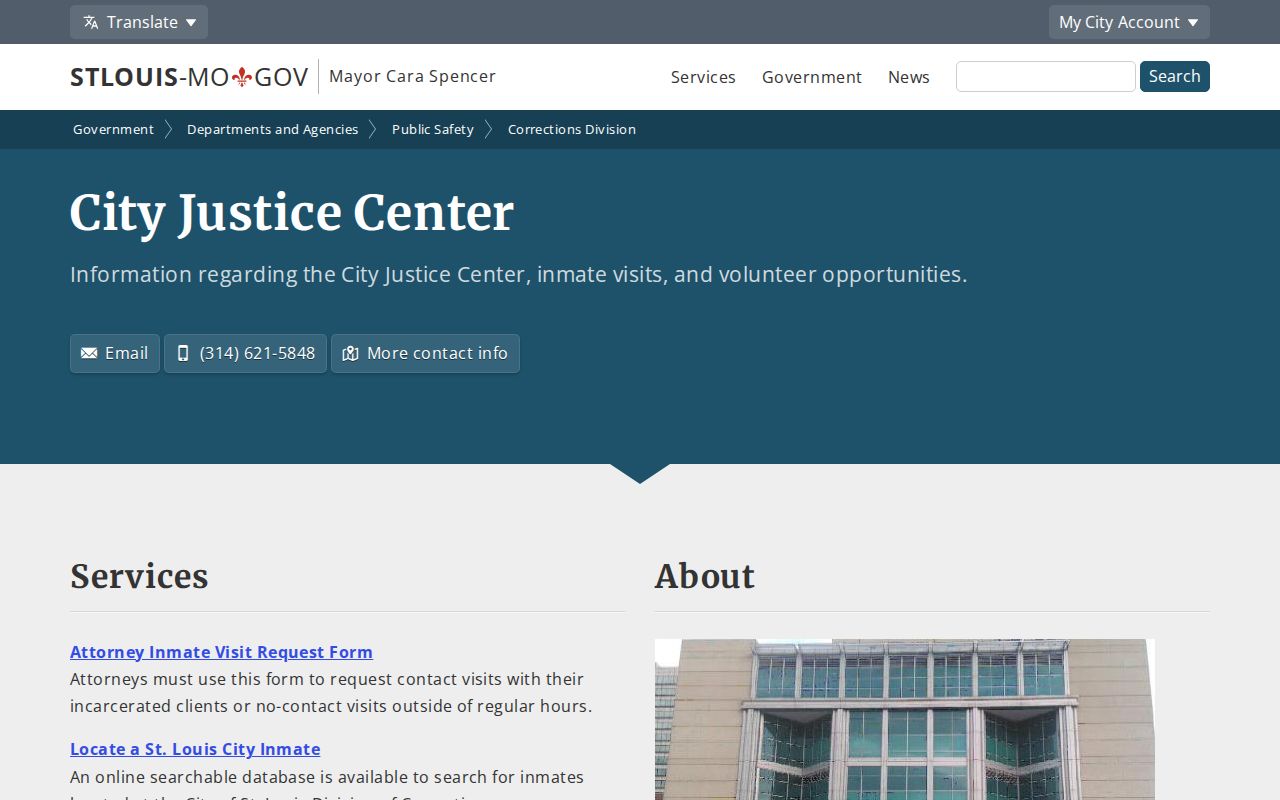
The facility page places the locator within the wider intake system, which helps explain why a public profile contains less detail than the complete jail file.
A current locator result is a custody snapshot. It is not a lifelong arrest index. When a person has been released or transferred, call the operator and ask about the right Corrections records route. For a currently confined person, the City says to press 1 for the operator and ask for the correctional caseworker when a letter of incarceration or related help is needed.
Arrest Records: What They Contain
The full record depends on the custodian. An SLMPD arrest report can contain alleged facts, the place and time, officers, cited offenses, involved people, and evidence. A CJC booking file focuses on intake and detention. Public release is narrower because juvenile, victim, medical, security, and personal-identifier data may be closed or redacted.
| Agency and report number | Names the arresting body and its identifier for the event report. |
|---|---|
| Arrest date and place | Records when and where custody began. |
| Legal authority | May state whether the arrest followed a warrant or warrantless probable cause. |
| Alleged offense | Lists the arrest offense or statute, which may differ from a later filed charge. |
| Master or booking number | Identifies the CJC intake and helps with custody services and record requests. |
| Admission and location | Shows booking time and the public custody location where released. |
| Charge, hold, and bond | Shows intake charges, other holds, and available bond information. |
| Photo and fingerprints | Created during intake, but not every item in the complete booking file is publicly displayed or released. |
| Release status | Records a release or transfer event when the public system provides it. |
| OCN | The eight-digit Offense Cycle Number links a reportable fingerprinted arrest to later state disposition reporting. |
Request St. Louis City Arrest Reports
When the public locator is too narrow, use the City Sunshine request process. Check the Open Data catalog and GOVQA Public Records Archive first. Then choose the City or SLMPD department group, sign in, and describe the exact arrest or incident record. Include the agency, report or booking number, event date, location, person’s name, requested component, and preferred electronic format. Ask for a cost estimate before broad research or duplication begins.
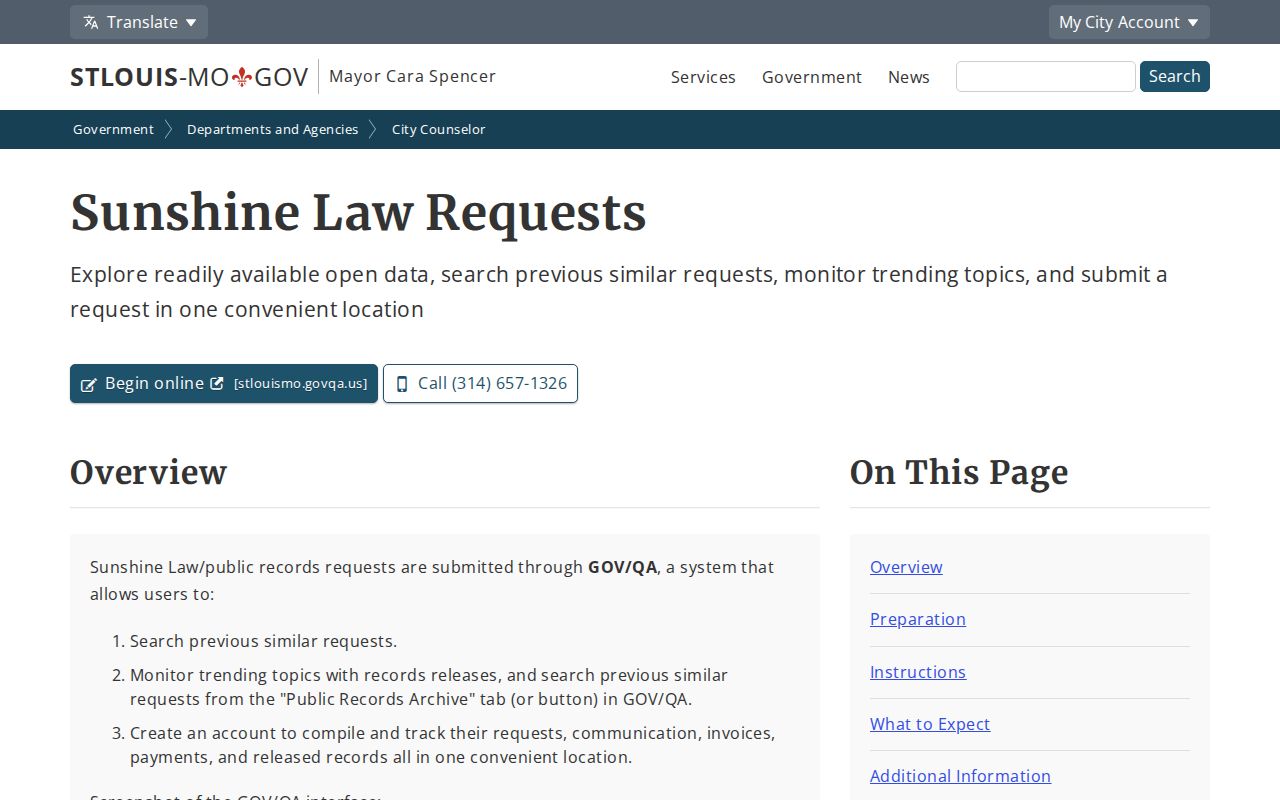
The City’s request guide shows why GOVQA is a tracked fallback rather than a second inmate search: it manages messages, invoices, payments, and released files from the actual custodian.
Missouri Sunshine Law requires a response by the end of the third business day after receipt. That deadline is not a promise that the full record will arrive within three days. If production takes longer, the custodian must explain the delay and provide the earliest date and time for access. City Sunshine assistance is available at 314-657-1326. Active-investigation details, juvenile information, victim data, and protected identifiers can be withheld or redacted under Chapter 610.
Recent St. Louis City Bookings
The City inmate locator searches people in Division of Corrections custody. Its controls use first name, last name, and a master or booking number where offered. A current profile can provide limited identity data, an inmate or master identifier, admission date, custody location, a charge or hold description, and bond information. The exact vendor display can change, so the locator should be read as a live status tool.
St. Louis City also publishes daily inmate population information. Population data counts people or custody conditions at a point in time. It is not a name-based arrest archive. Likewise, an entry can fall out of the current locator after release or transfer. No result can mean the person was released, transferred, not booked at CJC, entered under a different name, or is still being processed. It does not prove that no arrest occurred.
Note: Call CJC when a new booking is not yet visible, but use GOVQA for a released person’s historical booking record.
How St. Louis City Arrests Reach MSHP
For a reportable custodial arrest, fingerprints go to the Missouri State Highway Patrol CJIS Central Repository. The submission receives an eight-digit Offense Cycle Number. That OCN connects the arrest event to later prosecutor and court reporting. Courts and criminal justice agencies then send dispositions, sentences, custody, and supervision information back to the repository.
MACHS is therefore not the same as the CJC locator. A public name check searches open Missouri repository information and returns possible matches based on identifiers. It can include convictions, arrests less than 30 days old, filed charges awaiting disposition, and SIS entries during probation. Closed Missouri records and FBI records are excluded from that public product. A fingerprint review confirms identity and is the better official route for reviewing one’s own record.
Reporting delays, aliases, unmatched dispositions, and older paper records can leave gaps. If the repository lists the wrong person, MSHP provides an identity-challenge route using fingerprints. If the event belongs to the requester but has the wrong outcome, the contributing agency, court, and CJIS need the event identifiers and correct disposition documents.
Why St. Louis City Charges Change
A booking charge records why law enforcement and Corrections processed the person at intake. It is not the final charging decision. The Circuit Attorney’s Warrant Office reviews the police submission for state offenses and decides whether the evidence supports filing, which counts to file, and how to classify them. A later information or indictment may use different charges. Municipal ordinance matters follow the City Counselor and Municipal Division instead.
Case.net should be checked after enough time has passed for filing. Read each count, not just the case status. A prosecutor may decline to file, dismiss or amend a count, or enter a nolle prosequi. A judge or jury may acquit. A plea or finding may produce judgment and sentence. The St. Louis City court case lookup is the official path from the arrest allegation to the filed charge and final court outcome.
A dismissal does not automatically erase the SLMPD report or CJC booking record. Missouri expungement and other closure rules operate through separate legal procedures. A reader should not infer that a missing conviction means every record of the arrest has vanished.
Released From St. Louis City Custody
Once a person leaves CJC, switch from a present-custody search to record requests and downstream systems. Ask Corrections for the proper route to a historical booking record or letter of incarceration. Use GOVQA for releasable SLMPD and Corrections records. Search Case.net for a filed City case, and use Missouri DOC Offender Search if the court sent the person to state custody or supervision.
City Justice Center
200 S. Tucker Blvd.
St. Louis, MO 63102
314-621-5848
Open 24 hours; call for current custody and the correct Corrections records channel.
SLMPD Records Service Center
1915 Olive Street, first floor
St. Louis, MO 63103
Reports: 314-444-5551
Weekdays, 8 a.m.–4 p.m.; non-involved requesters use Sunshine review.
The SLMPD Records Service Center explains that involved-person report requests may require photo identification, proof of involvement, and, for some mail or online submissions, a notarized statement. A non-involved requester uses the Sunshine route. Special police agencies keep their own originating reports even when CJC later books the person.
Arrest Records vs Conviction Records
An arrest is an accusation and custody event. A conviction is a court judgment of guilt after a plea or trial. They are created at different times by different offices. Keeping that split clear is vital in St. Louis City because the public locator may update before any court case exists, and the eventual filed count can differ from the intake charge.
| Point | Arrest record | Conviction record |
|---|---|---|
| Created by | Arresting agency and City Corrections | 22nd Judicial Circuit after a guilty plea or finding |
| What it proves | An arrest or booking event occurred | The court entered a judgment of guilt |
| Main local source | SLMPD or agency report, CJC, and GOVQA | Case.net and the Circuit Clerk |
| Possible ending | Release, transfer, no filing, or later charge | Sentence, appeal, probation, or lawful closure |
| State layer | OCN-linked event when reportable | Disposition reported back to MSHP CJIS |
Compare the booking, court docket, and repository response before drawing a conclusion. Each source has a different scope and update cycle. The originating office is the best place to correct its part of the record.