
Criminal Court Cases in St. Louis City
St. Louis City is not part of St. Louis County. Its state criminal matters belong to the 22nd Judicial Circuit. Circuit Court hears state-law felonies and misdemeanors. The Circuit Attorney reviews police submissions and decides whether to file a complaint, information, or seek an indictment. Once filed, the clerk creates a case number and maintains the court file. Selecting St. Louis County in a search sends the reader to a different circuit and can make a City case seem missing.
The St. Louis Municipal Division is part of the same circuit structure, but it handles City ordinance matters such as traffic, dumping, housing-code, truancy, and other local violations. It does not try state felonies or misdemeanors. The City Counselor prosecutes ordinance cases, while the Circuit Attorney prosecutes state offenses. That split makes the offense and filing court more useful than the arrest address when choosing where to search.
Choose the Right St. Louis City Court
A records search should follow the charge, not just the place where police made an arrest. A state statute charge points toward Circuit Court. A City code or traffic violation points toward the Municipal Division. Family Court and its Juvenile Division handle juvenile matters at 920 North Vandeventer Avenue, but those records are generally restricted. Federal charges use the U.S. District Court and PACER, not Missouri Case.net.
The public counters also differ. Criminal proceedings use the Carnahan Courthouse at 1114 Market Street. The Circuit Clerk provides file and inspection services through the courthouse system and lists its main office at 10 North Tucker Boulevard, open weekdays from 8:30 a.m. to 5 p.m. The Municipal Division customer-service counter is at 1520 Market Street, Suite 1120, and its published phone is 314-622-3231. Calling the correct clerk saves a trip and helps locate a file that has not reached the web index.
St. Louis City Case Record Searches
Missouri Case.net is the first public search channel for a filed St. Louis City case. A case number gives the cleanest result. A party-name search is useful when the number is unknown, but common names require care. Search every likely spelling, use a middle name or birth date when the interface permits it, and verify the court before treating a result as the right person.
- Open Case.net and choose “City of St. Louis – 22nd Judicial Circuit,” not St. Louis County.
- Use Litigant Name Search with the legal surname and first name, or use Case Number Search when that identifier is known.
- For an ordinance matter, set Location to “St. Louis City Municipal” and Case Type to “Traffic/Municipal.”
- Open each result, use “Get Related Cases,” and read every charge, scheduled event, and docket entry.
- Ask the Circuit Clerk or Municipal Division for an older file, a public document without a link, or a certified copy.
| Field label | Type | Required | Search note |
|---|---|---|---|
| Search for cases in | Dropdown | Yes | Choose City of St. Louis – 22nd Judicial Circuit |
| Last Name | Text | For name search | Use the legal surname and test known aliases |
| First / Middle Name | Text | Recommended / optional | Narrows common-name results |
| Date of Birth | Date | Optional | City instructions use MM/DD/YYYY |
| Case Type / Location | Dropdowns | Optional | Use Traffic/Municipal and St. Louis City Municipal for ordinance cases |
| Case Number | Text | For number search | A traffic citation number appears at the upper right |
| Filing Date | Date range | Optional | Useful when many results share a name |
| Get Related Cases | Result control | No | Finds connected City results that a first list may omit |
Pre-2024 St. Louis City Cases
The Municipal Division moved its cases into Case.net in 2024. Many older files were imported, but a case filed before January 2, 2024 may not appear through the current online path. The City directs a person with a missing older municipal matter to bring photo identification to the customer-service window at 1520 Market Street or call the court. Municourt.net is no longer the City lookup system.
The City’s official Municipal Division search instructions show the exact Case.net court, location, and case-type choices.
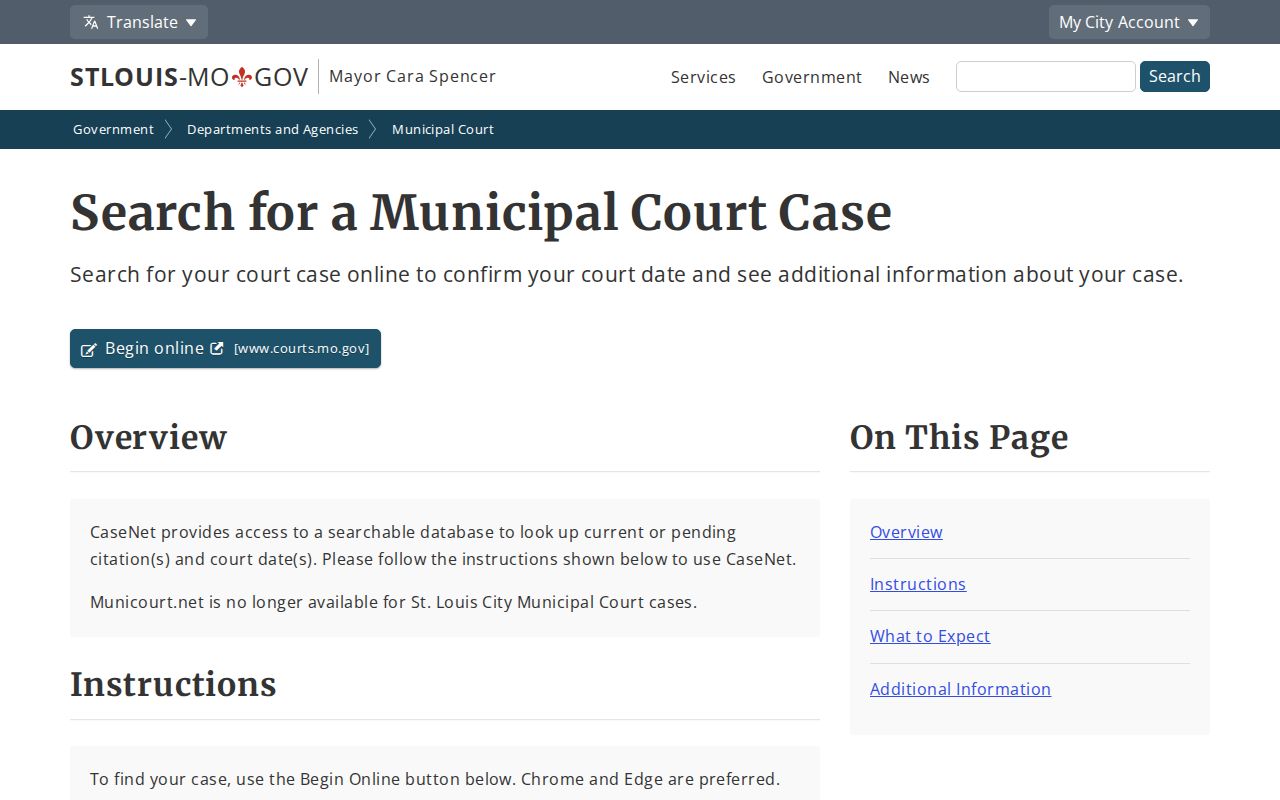
That local walkthrough is important because the statewide portal contains many courts, and a broad Missouri search can bury the correct City ordinance record.
Note: A citation may take time to enter Case.net, so a very new municipal matter may require a call to the court.
What a Criminal Case File Contains
A St. Louis City court file is case centered. It records the charge that a prosecutor actually filed, not merely the offense listed at booking. The useful reading unit is each count. A case can contain several counts with different statutes, classes, dates, and outcomes. A general status such as “disposed” only says the court finished work at the case level. It does not turn each count into a conviction.
| Case number and court | Identifies the filing, location, division, case type, judge, and current status. |
|---|---|
| Charging document | Shows the complaint, prosecutor-filed information, or indictment and the filed counts. |
| Parties and counsel | Lists party roles, attorneys, and the State or prosecuting authority. |
| Docket entries | Records filings, warrants, appearances, motions, continuances, pleas, and judgment events. |
| Hearing dates | Provides public event dates, hearing types, courtroom or division, and assigned judge. |
| Disposition and judgment | Gives the outcome and date for each charge, including dismissal, acquittal, plea, or finding. |
| Sentence and conditions | May show incarceration, probation, fines, costs, restitution, and related financial entries. |
| Public documents | Displays links only when an electronic attachment is available for remote public access. |
Read St. Louis City Docket Results
Case.net uses terms that can change the meaning of a result. “Nolle prosequi” means the prosecutor chose not to pursue a filed charge at that time. A dismissal ends the charge without a conviction. An acquittal is a not-guilty decision. A guilty plea or finding followed by judgment supports a conviction, while the sentence describes what the judge ordered.
- SIS
- A suspended imposition of sentence. The judge withholds imposition while probation is completed; it is not the same as expungement.
- SES
- A suspended execution of sentence. The court imposes a sentence but suspends its execution during probation.
- Information
- A charging instrument filed by the prosecutor.
- Indictment
- A charging instrument returned by a grand jury.
- ECASE
- A Case.net label indicating that the electronic court file is the official file.
A hyperlinked docket entry has a document available to that user. An entry without a link may have no attachment or may be withheld from remote access. The event text still helps establish when a plea, motion, judgment, or sentence occurred.
Criminal Case Stages in St. Louis City
Police first send an arrest or investigation to the Circuit Attorney’s Warrant Office. Prosecutors then decide whether the facts support state charges and which charges to file. A judge addresses probable cause and release. A felony may proceed through a preliminary hearing or grand jury before arraignment. Pretrial work can include discovery, motions, and scheduling. The case ends through dismissal, plea, trial, or another lawful disposition, followed by judgment and sentencing when guilt is found.
Case flow: Charges Filed › Arraignment › Pretrial › Plea or Trial › Disposition › Sentencing
This sequence explains why a CJC booking charge and a Case.net charge can differ. The booking reflects the custody event. The filed court count reflects the prosecutor’s decision after review. Later amendments and count-specific outcomes may change the public docket again. For a complete view of the custody event before filing, compare the court case with the official St. Louis City arrest search.
St. Louis City’s Five Million Files
The Circuit Clerk reports holdings that begin in 1804 and total about five million files. That span reaches far beyond the era of electronic dockets. Case.net is strong for current indexing and public docket events, but it cannot stand in for a search of the full local archive. An older case, a paper exhibit, or a public document that was never scanned may require clerk staff and an in-person inspection.
The official Circuit Clerk page supplies the local office and court-record context.
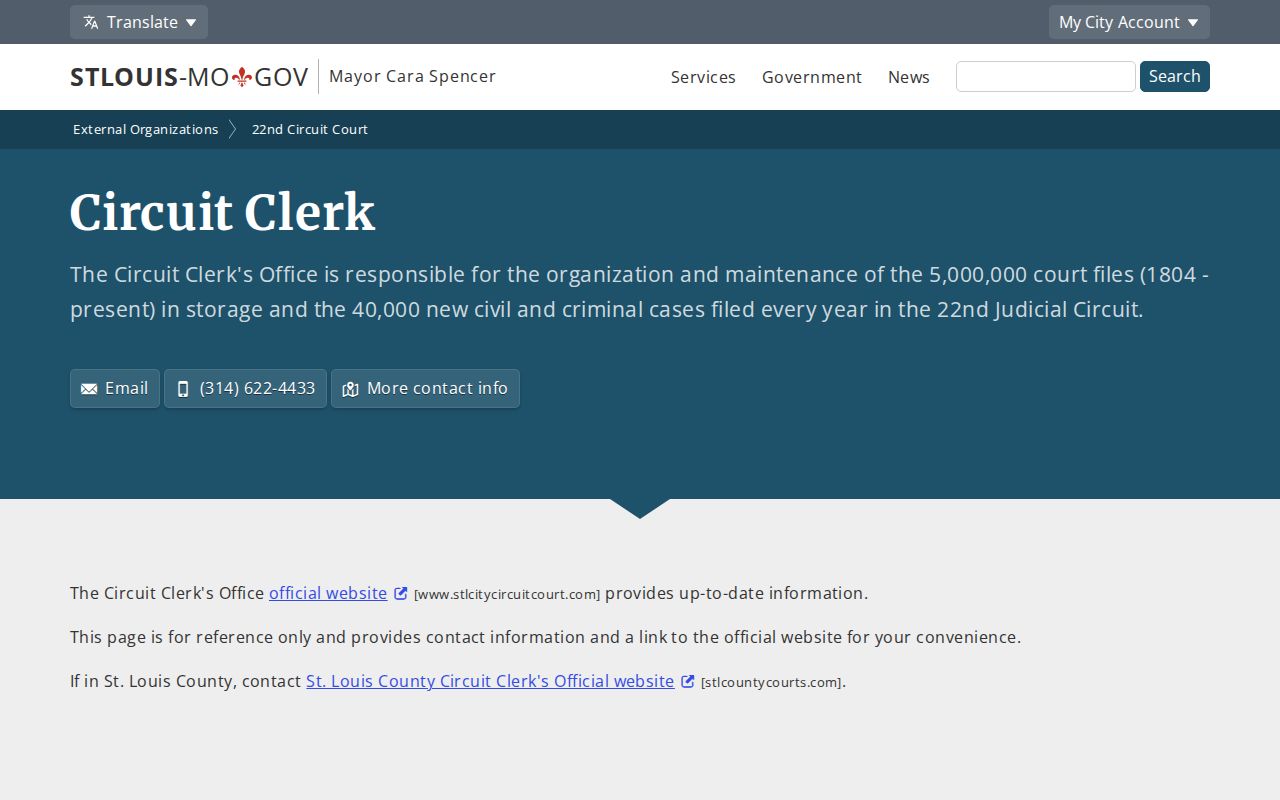
The clerk’s published record span puts a missing web result in context: it may call for archive help rather than a broader name query.
Retrieve Missing St. Louis City Files
Start with the case number, full party name, approximate filing year, and court division. Call the Circuit Clerk at 314-622-4433 for state cases or the Municipal Division at 314-622-3231 for ordinance matters. Ask whether the file is electronic, archived, restricted, or available for inspection. Also ask about the current plain-copy, certified-copy, and archive-retrieval charges before ordering, since the reviewed official pages did not provide a clear current fee table.
The Circuit Clerk’s main public service location is listed at 10 North Tucker Boulevard, St. Louis, Missouri 63101, with weekday hours of 8:30 a.m. to 5 p.m. Municipal Court customer service is at 1520 Market Street, Suite 1120, St. Louis, Missouri 63103, with weekday hours of 8 a.m. to 5 p.m., except City holidays. An exact case number lets staff separate St. Louis City from similarly named courts and parties.
Access Rules for Case Records
Missouri Court Operating Rule 2 governs public access to judicial records. Public Case.net entries can include the case style, charges, hearings, disposition, sentence, and some linked documents. Confidential categories are not exposed. Juvenile files, protected victim information, full personal identifiers, and sealed or closed records may be restricted. Some public documents may be available at a courthouse terminal even when remote access is limited.
If a known St. Louis City case does not appear, verify the jurisdiction and spelling, use related cases, and contact the clerk. Do not infer that no case exists. A record may be too old for the index, recently filed, confidential, expunged, or listed under a different name. Court records also answer a narrower question than a Missouri State Highway Patrol criminal-history response.
Note: An online docket is a public access layer, while the Circuit Clerk remains the custodian of the official St. Louis City case file.