
St. Louis Criminal History Checks
There is no single complete local file. St. Louis Metropolitan Police Department records contain the incident and arrest narrative. The City Division of Corrections creates a booking record when someone enters the City Justice Center. Municipal Court tracks ordinance and traffic matters, while the 22nd Judicial Circuit handles state felonies and misdemeanors. Missouri Case.net publishes court docket data, and MACHS supplies a paid statewide repository check. Choose the channel based on the event and the fact that needs proof.
- Begin with SLMPD for a City incident or arrest report. An involved person can use the records counter or official form; others use the Sunshine request route.
- Check the St. Louis City inmate locator for current City custody. Call the City Justice Center when intake may be too recent for the online result.
- Search Case.net under “City of St. Louis - 22nd Judicial Circuit.” Use the St. Louis City Municipal location for ordinance and traffic cases.
- Ask the Circuit Clerk for filed documents, older files, or a case that is not fully available online. The clerk's archive reaches back to 1804.
- Use MACHS when statewide open repository data is needed, or the fingerprint route to review one's own identity-confirmed Missouri record.
These results should be compared, not merged without care. A police allegation can differ from the prosecutor's filed charge. A current inmate search says little about the final case outcome. A name-based state response can also identify a possible rather than fingerprint-confirmed match.
St. Louis Independent City Records
St. Louis left St. Louis County in the 1876 “Great Divorce.” The City now operates as both an incorporated place and a county equivalent. It performs judicial and revenue functions that a county government would normally handle. The distinction changes searches in Case.net, the Missouri registry, Census data, and agency requests. Selecting St. Louis County directs the search to the surrounding jurisdiction and its Clayton offices, not to a record made inside the City boundary.
The official St. Louis government structure explanation shows how county-type functions fit within City government.
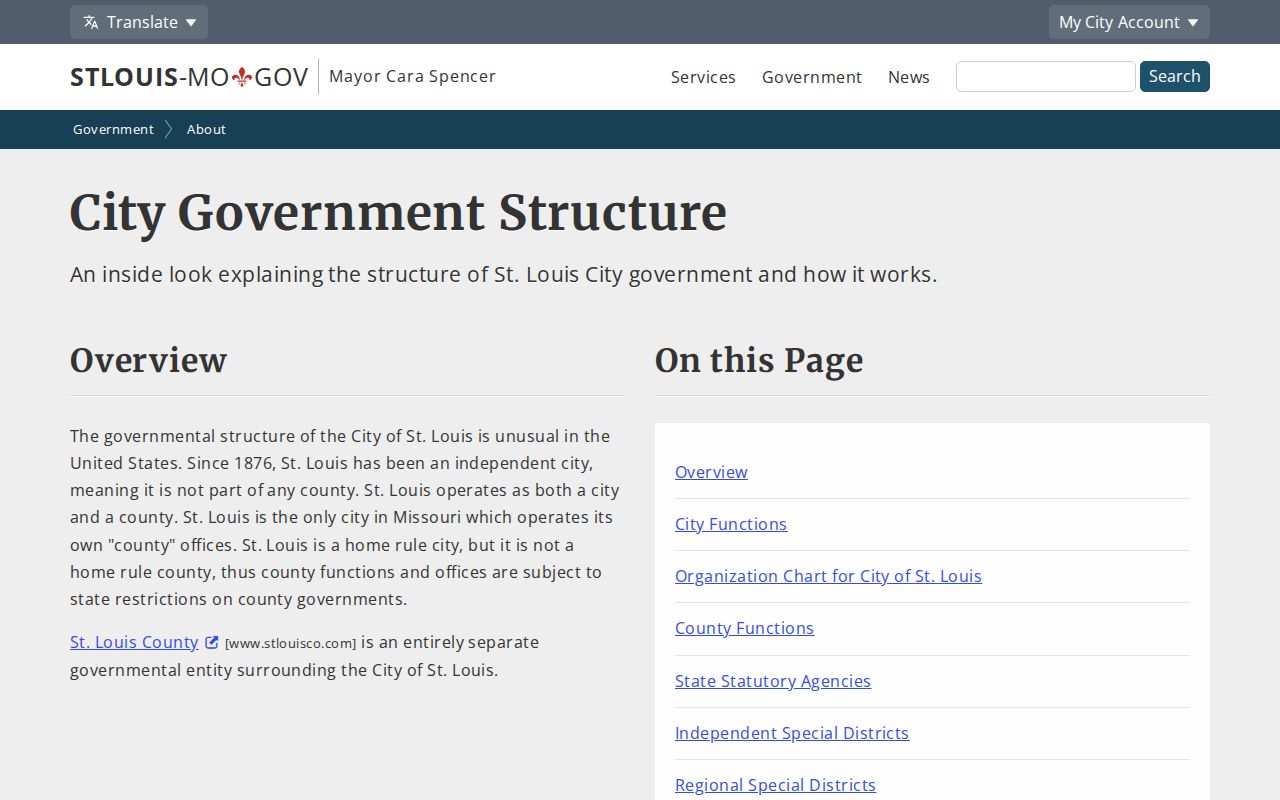
That independent structure explains why the City has one local city guide and no subordinate incorporated municipalities: St. Louis is itself the only incorporated city in this county-equivalent geography.
Records at the St. Louis Police Department
SLMPD's Records Service Center is at 1915 Olive Street, first floor, St. Louis, MO 63103. The counter is open from 8 a.m. to 4 p.m. on weekdays. The published report line is 314-444-5551, while local record-check questions go to 314-444-5541. An involved person can seek an incident or crash report with photo identification. Attorneys, insurers, and people who were not involved are routed to the City's Sunshine review process.
The official report request form asks for the requester's name, phone, email, role in the event, incident date, complaint number, involved names, incident type, and location. Role choices include driver, passenger, pedestrian, property owner, victim, or suspect. Mail and online requests from involved people require notarized identity and involvement statements. The form also allows a qualifying relative or authorized person to document that authority. These fields help SLMPD find the right file and determine which portions can be released.
The official SLMPD site identifies the department and routes residents to current police services.
Use the Records Service Center for the originating police file, then use the court or corrections channel for what happened after the report.
SLMPD Record Check Products
SLMPD offers two local check products. A City-only check costs $4.50. A City-and-County check costs $9 and covers a broader local pairing, but it still does not become a full statewide or FBI history. The official form asks for the subject's name, middle and maiden names, birth date, race, sex, Social Security number, address, phone, request basis, selected product, delivery choice, signature, and identification. Authorization and notarization fields apply in some circumstances.
| Product | Published fee | Scope |
|---|---|---|
| City-only local check | $4.50 | SLMPD's local St. Louis City record product |
| City-and-County local check | $9 | Combined local product named on the SLMPD form |
| MACHS name search | $15 plus payment processing | Open Missouri Central Repository information and possible name matches |
| MACHS fingerprint route | Published components vary by authorized search | Identity-confirmed Missouri review and authorized FBI layer where permitted |
The SLMPD page gives inconsistent summaries of accepted payment methods, and its form says not to mail payment before the agency gives instructions. Call before visiting or sending a request. A person reviewing their own record should choose the product that matches the needed geographic scope and level of identity certainty.
St. Louis Crime Map Limits
SLMPD divides St. Louis into six districts served from three patrol stations. South Patrol covers Districts 1 and 2 from 3157 Sublette. Central Patrol covers Districts 3 and 4 from 919 North Jefferson. North Patrol covers Districts 5 and 6 from 4014 Union. The official neighborhood locator accepts an address or an 11-digit parcel number, which helps identify the right district before seeking a report or comparing public safety trends.
The public crime map is not a criminal history search. It plots preliminary incidents at the 100-block level, updates daily, and retains 180 days. It omits domestic violence, sex crimes, and offenses with juvenile victims for privacy. A map point therefore cannot identify a person, prove an arrest, or reconstruct a full police report. Monthly CompStat material organized by City, neighborhood, district, and patrol is a better trend source. Even then, do not blend incident totals with court filings or current jail counts, since each source measures a different step.
St. Louis's fixed boundary also affects rate comparisons. The City total excludes suburban St. Louis County, so a valid comparison must use the same geography, time period, and data definition.
Booking and Arrest Records in St. Louis
An SLMPD arrest can create several linked but distinct records. The officer writes an incident and arrest report. Corrections intake creates the City Justice Center booking file, records the master number, photographs and fingerprints the person, inventories property, and records charges, holds, bond, and release data. A reportable fingerprint submission receives an eight-digit Offense Cycle Number that links the arrest cycle to later charges and dispositions in Missouri's Central Repository. The Circuit Attorney then decides whether state charges will be filed.
The City inmate locator is the first public check for current custody. If the booking is very recent, call the City Justice Center at 314-621-5848. A person who has been released may no longer appear in the current locator. For a historical booking or letter of incarceration, use the Corrections request route through GOVQA. Case.net should be checked after enough time has passed for a prosecutor and court filing. The full channel sequence appears in the dedicated St. Louis City Arrest Search.
Absence from one system does not clear the others. A person may have been released, transferred, never booked at CJC, or not yet entered in the court system.
St. Louis Justice Center Custody
The City Division of Corrections, not the elected Sheriff, operates the City Justice Center at 200 South Tucker Boulevard, St. Louis, MO 63102. The six-story facility opened in 2002, has a published capacity of 860, and operates around the clock. The Sheriff focuses on courtroom security, service of process, prisoner transport, and related court duties. Sending an SLMPD report request or a booking-file question to the Sheriff is therefore a local routing error.
CJC services include the inmate locator, bond information, medical-record requests, property return, visitation, inmate money, phone accounts, and daily population data. For a currently confined person's historical letter or file question, call the operator and ask for the correctional caseworker. Released-person records use the Corrections or GOVQA route. Medical, classification, security, and protected identity details may be withheld even when basic booking information is public.
The master number is a key identifier. It helps with custody inquiries and is required in the facility's inmate mail format. Current custody should not be confused with a conviction or state prison sentence.
The St. Louis Municipal Court File
St. Louis Municipal Court hears City ordinance and traffic cases, including matters involving dumping, housing codes, problem properties, truancy, earnings tax, and minor alcohol or drug ordinances. It does not hear Missouri felony or misdemeanor prosecutions. Those state-law charges belong to the 22nd Judicial Circuit. This split matters because two events that look similar may have different prosecutors, case types, locations, and clerks.
| Court name | St. Louis Municipal Division of the 22nd Judicial Circuit |
|---|---|
| Case types | City ordinance and traffic matters, not state felonies or misdemeanors |
| Online lookup | Case.net with “City of St. Louis - 22nd Judicial Circuit,” St. Louis City Municipal location, and Traffic/Municipal case type |
| Docket contents | Case number, parties, charge, events, hearing settings, disposition, judgment, and public financial entries where available |
| Older-case fallback | Photo-ID counter inquiry or phone contact for a pre-2024 matter not found online |
The official St. Louis Municipal Court page supplies the current court channel and location.
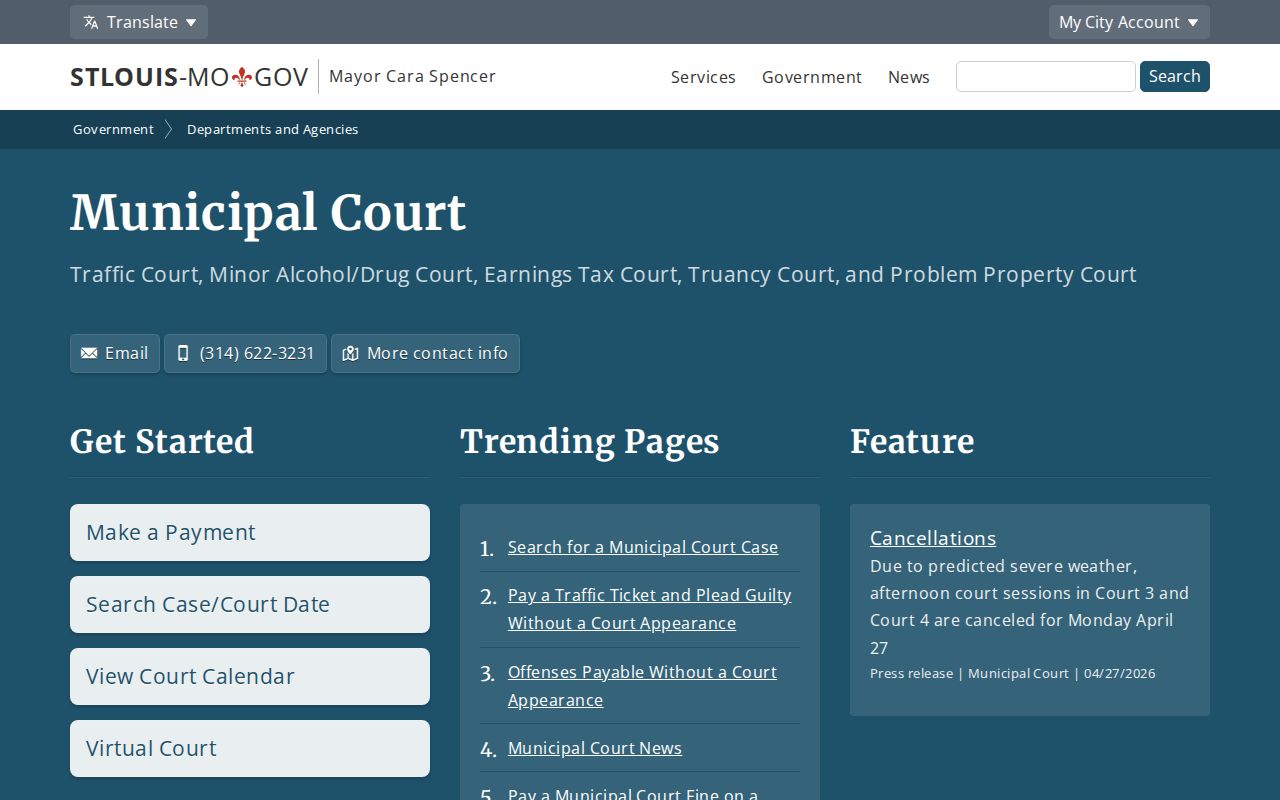
Municipal customer service is at 1520 Market Street, Suite 1120, St. Louis, MO 63103, with weekday hours from 8 a.m. to 5 p.m. and phone 314-622-3231.
St. Louis Court Record Geography
The downtown court cluster is compact, but each office is a separate custodian. The Circuit Clerk works from the Civil Courts Building at 10 North Tucker Boulevard and reports about five million files dating from 1804. Criminal proceedings also use the Carnahan Courthouse at 1114 Market Street. Municipal Court sits at 1520 Market. The City Justice Center is at 200 South Tucker. A short walk between buildings does not make their files interchangeable.
Case.net is strong for current docket data, yet it is not the full two-century archive. Older and nonelectronic documents may require the clerk's help. Municipal cases moved into Case.net in 2024. If a pre-January 2, 2024 City ordinance matter does not appear, the City directs the requester to call or bring photo ID to the Municipal Court counter. Municourt.net is no longer the official lookup.
For a filed state case, the fuller path is the St. Louis City Court Case Lookup, which separates charges, motions, pleas, dispositions, and sentences from the earlier police event.
How St. Louis Records Reach the County
St. Louis records do not reach a separate county government because the City performs its own county functions. The phrase “county level” here means the City's 22nd Judicial Circuit and county-equivalent offices. An officer creates the report, Corrections creates the booking file, the Circuit Attorney reviews state charges, and the court opens a case when charges are filed. Dispositions then flow back to the Missouri State Highway Patrol Central Repository.
Record flow: SLMPD › City Justice Center › St. Louis 22nd Judicial Circuit › Missouri State Highway Patrol CJIS
The sequence explains timing gaps. A fresh arrest can appear in custody before a court case exists. Filed charges can differ from the booking allegations. A dismissal ends the court charge but does not erase the original agency report. MACHS and Case.net may update on different schedules, and a name check can return a possible match. Use the newest system for current custody, the originating agency for the incident narrative, the court for the legal outcome, and MSHP for the statewide repository response.
St. Louis GOVQA Record Requests
GOVQA is the main City fallback when an SLMPD, Corrections, Medical Examiner, or other City record is not already public. Start with the City Open Data catalog and the portal's Public Records Archive. An existing release can save time and fees. If no match exists, choose the City or SLMPD department group, create an account, describe the record, and track questions, invoices, payments, and released files through that account.
A focused request names the agency, record type, event date range, incident or booking number when known, and preferred electronic format. For an SLMPD report, include the location and exact component, such as the incident report, arrest report, CAD or 911 material, or body-camera video. Ask for a cost estimate before broad research. The City Sunshine help line is 314-657-1326. The City Counselor's office is at 1200 Market Street, Room 314, St. Louis, MO 63103.
Active investigations, juvenile data, victim identities, medical details, full personal identifiers, and parts of audio or video may be withheld or redacted. A request can still yield open basic facts even when the full investigative file is closed.
St. Louis Record Access Rules
The Missouri Sunshine Law favors access but preserves specific exceptions. It also assigns each public body a records custodian. That means the most effective St. Louis request goes to the office that created or maintains the file: SLMPD for its report, Corrections for booking records, the clerk for filed court documents, and MSHP for repository history. Judicial records also follow Missouri Court Operating Rule 2.
Key access rules:
Section 610.011 directs courts to read Chapter 610 broadly for openness and exceptions strictly.
Section 610.023 requires a response by the end of the third business day, with a written explanation when production takes longer.
Section 610.100 governs arrest and investigative reports, including open basic arrest information and closure rules.
Missouri Court Operating Rule 2 controls public court access and protects confidential or redacted judicial data.
The three-business-day rule is a response deadline, not a guarantee that every file will be produced within three days. If immediate access is not possible, the custodian must explain the delay and state the earliest expected production time. Research, duplication, and electronic-media costs may apply. Request electronic delivery when it fits the record.