
St. Louis City Sex Offender Checks
The Missouri Sex Offender Registry is the main public channel for a St. Louis City sex offender lookup. The Missouri State Highway Patrol Criminal Justice Information Services Division maintains it from data supplied through local registration. Searchers can start with a person's true or alias name, a date of birth, or a location. A radius query is more useful when the goal is awareness near a home, school, park, or other known place. At least one person-search criterion is required, while a radius search needs a usable location and distance.
St. Louis is a city not within a county. That legal structure matters on the registry. A filter for St. Louis County points to a separate jurisdiction outside the City boundary. Use the distinct St. Louis City or city-not-within-county choice shown by the live form. The registry is updated from official registration reports, but it does not guarantee that every address, map point, or identity is current. Positive identity requires fingerprint comparison. For that reason, treat a result as a lead for careful review, not as a basis for confrontation.
St. Louis City Registry Filters
The most common local mistake is choosing the surrounding county because both jurisdictions share the St. Louis name. The City has held county-equivalent status since its 1876 separation from St. Louis County. Registry filtering follows that split. For an address inside the independent City, enter St. Louis as the city, Missouri as the state, and then select the specific City jurisdiction offered by the registry. A street or ZIP search can narrow the result when the jurisdiction label is unclear.
Address Type also changes what the search returns. The St. Louis City registry form can account for residence records as well as incarcerated or moved-out-of-state records. That distinction helps when a known person does not appear under a current home address. Search both true names and known aliases, and use date of birth when it is known. Similar names are not proof of a match. Compare the photograph, physical description, aliases, conviction jurisdiction, and registration number before drawing any conclusion.
Missouri Sex Offender Registry Searches
The official St. Louis City registry channel offers a person search and a location-radius search. The first works best when a name or date of birth is known. The second shows public registrations around an address. The live interface may change, so read each label and the conditions of use before submitting a search.
- Open the official Missouri registry and review its identity, map, and lawful-use notices.
- Choose a person search or enter a complete address for a radius search. Select St. Louis City, not St. Louis County.
- Add a first name, date of birth, tier, address type, or ZIP to reduce false matches. The registry also searches aliases.
- Open a possible profile and compare the public photo, descriptors, status, offense record, and registration details. Contact the official agency if key facts conflict.
| Field label | Type | Required | Use |
|---|---|---|---|
| Offender name and birth date | Text and date controls | One criterion | Searches true names and aliases; added details improve precision |
| Predator and tier level | Dropdowns | No | Filters offered status and Tier I, II, or III values |
| Address type | Dropdown | No | Can include residence, incarcerated, or moved-out-of-state records |
| Street, city, county, state, ZIP | Text and dropdowns | One location criterion | Use the independent St. Louis City jurisdiction |
| Street address and distance | Text and dropdown | Yes for radius | Creates a proximity search around a known location |
A broad last-name query can return many possible people. Narrow it with a first name, birth date, address type, or location before comparing the full profiles.
St. Louis Registry Official
Missouri law assigns registration work to the local chief law enforcement official. In an independent city, St. Louis performs that local role itself. The St. Louis Metropolitan Police Department is therefore the St. Louis City registry contact for compliance and local corrections, while MSHP runs the public statewide database. This division of work explains why a user may need both agencies: MSHP can address the public portal, but a home address or verification detail begins with the local registration record.
Missouri collects far more during registration than it necessarily publishes. Under section 589.407, local registration may include identity data, residence, phone, vehicle information, online identifiers, work or school status, offense facts, and proof of residency. The public fields are governed separately by section 589.402. Sensitive data such as a Social Security number is collected for official use but is not displayed as a public search field. This collected-versus-published split is a core privacy limit of the registry.
Questions about local registration compliance can be directed to SLMPD at 314-444-5302. A suspected error should be described with the profile or registration number and the exact field at issue. For statewide registry help, MSHP lists 573-526-6348 and mosor@mshp.dps.mo.gov.
Registry Profiles: What They Show
A St. Louis City registry profile joins identity, location, offense, and compliance fields. The display can contain a current photograph, true name, aliases, alias birth dates, public physical descriptors, registration number, tier, status, and predator designation when applicable. It may also show residence, work, or school information within the public scope of Missouri law. Offense entries can identify the conviction jurisdiction, statute or description, adjudication date, and limited victim category. Vehicle and distinguishing-mark fields aid confirmation.
| Name and aliases | True and alternate names, with alias birth dates when public |
|---|---|
| Photo and description | Photo plus sex, race, height, weight, hair, eyes, age, or birth date as authorized |
| Address fields | Public residence, work, school, incarceration, or moved-out-of-state status |
| Offense record | Jurisdiction, statute or description, conviction date, and permitted victim category |
| Tier and status | Tier, registration status, predator designation, and verification dates where shown |
| Other identifiers | Vehicles, plates, scars, marks, tattoos, and the local registering agency |
Not every blank field means the person failed to report. A value may be withheld, inapplicable, still processing, or outside the current public scope. Verify a meaningful conflict with the registering agency.
St. Louis City Registry Status Terms
Status words need context. “Pending Registration” does not automatically mean “wanted” or “absconded.” It can mean that a move to another Missouri county was reported but the next local registration is not complete. It can also reflect an intended release address supplied by the Department of Corrections before local registration occurs. Those are workflow states, not proof of a new crime.
- Tier
- A statutory class tied to offense rules, registration duration, and verification duties, not a user's personal risk score.
- Pending registration
- A reported move or intended address that has not yet completed the next local registration step.
- Verification
- The periodic in-person duty set by Missouri law for the assigned tier and status.
- Positive identity
- Identity confirmed by fingerprints rather than a name, address, photograph, or map result alone.
Read the status with the profile's dates and local agency field. If those details conflict, ask the registration official to review the source record.
Registration Levels and Duties in Missouri
St. Louis City registry records use Missouri's three statutory tiers. The registering official assigns the tier from the qualifying offense and section 589.414. It is not assigned by neighborhood reaction or by how a profile looks. The tiers drive the general registration period and frequency of in-person verification. Removal or reduction is not automatic merely because a listed period has passed; the person must meet the statute's conditions and any required petition process.
| Tier | General duration | Verification concept |
|---|---|---|
| Tier I | 15 years; possible five-year reduction after a qualifying ten-year clean record | Periodic in-person verification under section 589.414 |
| Tier II | 25 years | More frequent statutory verification than Tier I |
| Tier III | Life; a special route may apply to a qualifying juvenile adjudication after 25 clean years | Most frequent statutory verification |
Initial local registration may cost up to $10, and later changes may cost $5 each under section 589.400. Those are registration charges, not fees to run a public search.
St. Louis City Registry Distance Rules
Missouri's official registry fact sheet identifies several distance limits for covered people. Section 566.147 addresses certain residences within 1,000 feet of a school, child-care site, or victim residence. Sections 566.148 and 566.149 address presence or loitering within 500 feet of child care and school property. Section 566.150 covers certain conduct within 500 feet of a public park, pool, athletic complex, museum, or nature center.
A St. Louis City registry radius map does not decide whether any one limit applies. The answer depends on the offense, date, legal status, precise site boundary, and wording of the controlling law. Map geocoding can also shift a point. Use the map for awareness and research, not as a survey or legal finding. A pin near a landmark does not by itself prove a violation.
St. Louis City Registry and NSOPW
The Missouri registry is the best first layer for local address types, Missouri tiers, and St. Louis City filtering. A national search becomes useful when a person may have lived or registered in another state, territory, or tribal jurisdiction. The U.S. Department of Justice National Sex Offender Public Website searches participating public registries from one place, while each source jurisdiction still controls its own data and update cycle.
The official NSOPW search provides the national source view shown below.
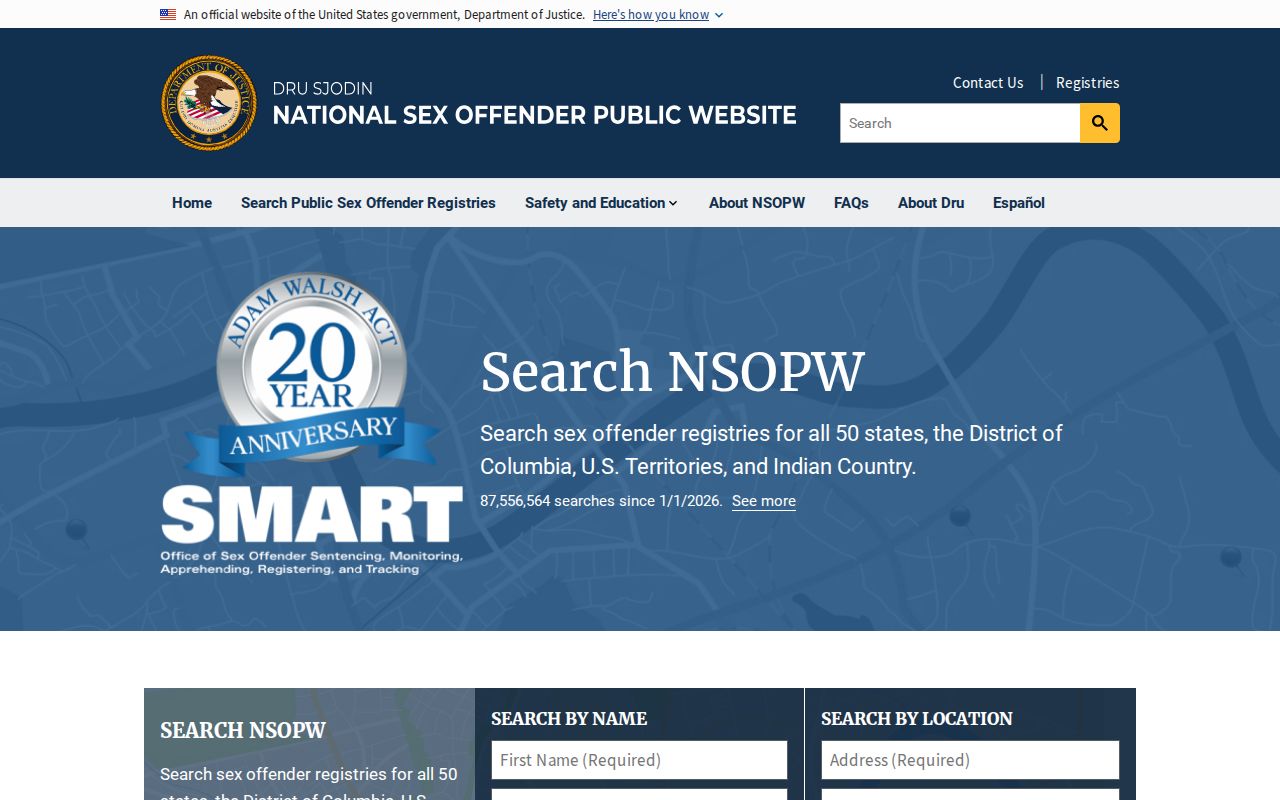
Use that national layer to find possible records elsewhere, then open the originating jurisdiction's profile to read its status terms and correction channel.
St. Louis City Registry Corrections
When a St. Louis City registry profile has a wrong address, missing fact, or misplaced map point, note the exact field before calling. Save the profile or registration number, the date checked, and a screenshot of the displayed location if the map is at issue. Send local address or compliance questions to SLMPD. Send public-portal questions to the MSHP registry contact. This keeps the report with the agency able to review the source submission.
Do not substitute social media, neighborhood posts, or a third-party list for the official correction route. Those sources can repeat old data long after an agency changes its record. The official registry itself also warns that fingerprint comparison is needed for positive identity. A careful correction report states what appears wrong and why, without publishing personal claims or approaching the listed household.
Using Registry Information Lawfully
Registry data supports personal and family safety, community awareness, and informed contact with public officials. It does not authorize threats, harassment, trespass, vigilantism, or misuse of a listed household's information. The profile may be incomplete or out of date, and an address can include other people who are not registrants. Check the official status, distinguish City from County, and report concerns to law enforcement rather than acting on a map result.
Lawful-use warning: Missouri's official registry and section 43.533 warn against using registry information to facilitate a crime. Never threaten, harass, intimidate, or target a registrant or household.
Failure to meet registration duties can carry criminal penalties under section 589.425. Whether a person is noncompliant is an official determination. A public user's role is to pass a specific concern to the local registration official, not to declare guilt.